
Story introduction
It is a story that made the Five Tibetans famous. The author of the story is Peter Kelder and his book is called Ancient Secret of the Fountain of Youth (in Czech Pět Tiběťanů – Five Tibetans).
The book tells us about the beginning of the last century, when a retired British army officer named Bradford meets Mr. Peter Kelder and tells him that there is a monastery in Tibet where the monks know a secret of eternal youth.
For a while he was trying to talk Mr. Kelder into going to Tibet with him and finding the monastery. The officer left alone eventually. It must be noted that he was a grey-haired man with a cane that was about to turn sixty.
Officer Bradford came back to England 23 years later and his friend couldn’t have recognized him. The officer looked like he was 45 with his dark hair and straight walk. He said that he found the monastery in Tibet, lived there with the monks, grew vegetables and made goat cheese and he also learned Tibetan monks’ secret exercise that keeps you healthy.
Mr. Kelder had been writing down Bradford’s stories for a couple of weeks and published a book afterwards that got translated into a lot of languages.
A system of five Tibetan exercises (that used to be among banned literature dealing with alternative ways of healing known already in the period of the first Czech Republic) showed up after 1989 with a new publication of the book. There now are hundreds of people and fitness clubs in the whole country doing this Five Tibetans exercise.
Technique: five exercises – five rites
Five Tibetans consists of five exercises. These are called rites and are done in a row in the way they are written down. There’s a short pause between every each of them (1-2 minutes) to relax. The number of repetitions is individual. You usually start with 3-5 repetitions and add one more every week.
The exercise is not supposed to be demanding but relaxed and relaxing. You can repeat every exercise depending on how you well when doing it.
It is important to get it regularly, think about the movements and don’t think about anything else.
First Rite: Clockwise Spin
Starting position
Stand up straight with arms outstretched, horizontal with the shoulders. Legs are stretched and head is upright.
Movement
Spin around taking little steps around your axis from left to right. Every 360 degrees is the exercise done once. It is better to spin slowly, keeping your breath on mind.
Breath
You breathe deeply and naturally during the whole spinning.
Function
The aim of the First Tibetan is to increase the organism’s energy. Upright stand gives you stability, self-confidence and vitality.
Second Rite: Leg Raise
Starting position
Lie full length on your back, place the hands flat alongside of the hips. Fingers should be kept close together with the finger-tips of each hand turned slightly toward one another. Legs are stretched out.
Movement
Raise the feet until the legs are straight up, chin touches the chest and legs are in right angle with the floor. Back and hips touch the floor, knees are stretched out. Hold this position for a moment or two and then slowly lower the feet to the floor, and for the next several moments allow all of the muscles in the entire body to relax completely.
Breath
Breathe in slowly and deeply when raising the legs and head and breathe out when lowering them.
Function
Strengthens belly and back muscles and helps the metabolism. It gives you a dynamic appearance and removes back issues.
Third Rite: Kneeling Backbend
Starting position
Kneel on a rug or mat with hands at sides, palms flat against the side of legs. You kneel on fingers (not instep). Calves and tights are in right angle, legs not tightly connected, arms are under your buttocks ready to support the core in bending, chin touches chest.
Movement
Lean backward as far as possible. Cause the head to move still further backward, with no stress and pain. The toes will prevent you from falling over backward. The hands are always kept against the side of the legs. Next come to an erect (kneeling) position and relax as much as possible for a moment.
Breath
Breathe in when bending and breathe out when bending forward.
Function
The Third Tibetan is supposed to improve the heart activity, strengthen immunity and neck muscles. It strains the whole core, especially spine, shoulders, chest and neck. It strengthens the leg joints and gives kidneys more oxygen.
Fourth Rite: Table Top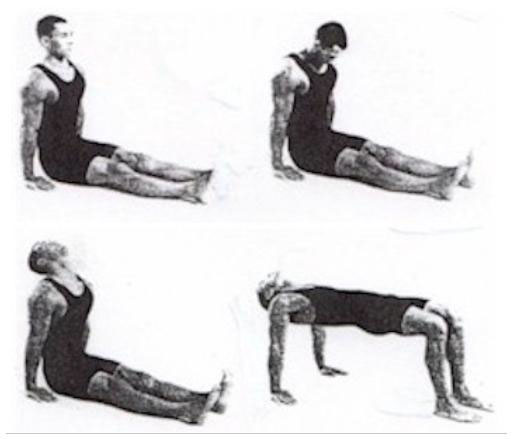
Starting position
Sit erect on rug or carpet with feet stretched out in front. The legs must be perfectly straight — back of knees must be well down or close to the rug. Place the hands flat on the rug, fingers together, and the hands pointing outward slightly. Chin should be on chest — head forward.
Movement
Gently raise the body, at the same time bend the knees so that the legs from the knees down are practically straight up and down. The arms will be vertical while the body from shoulders to knees will be horizontal. As the body is raised upward allow the head gently to fall backward so that the head hangs backward as far as possible when the body is fully horizontal. Hold this position for a few moments, return to first position, and relax.
Breath
Breathe in when raising body, keep your breath in the upper position and breathe out when going down.
Function
The exercise stimulates the endocrine systems, strengthens spine, strains core and animates digesting and excreting. It strengthens wrists.
Fifth Rite: Pendulum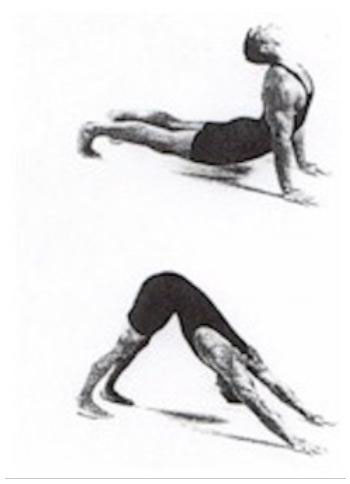
Starting position
Lie on your belly with face to the floor. Place the hands on the floor about two feet apart to your shoulders and lean against your toes (similar to Cobra in yoga).
Movement
Then, with the legs stretched out to the rear with the feet also about two feet apart, push the body, and especially the hips, up as far as possible, rising on the toes and hands. At the same time the head should be brought so far down that the chin comes up against the chest. Next, allow the body to come slowly down to a ‘sagging’ position. The movement should be slow and relaxed.
Breath
Breathe in when raising the hips and breathe out when coming back to the starting position.
Function
The exercise helps the endocrine system, stretches neck, core and belly muscles, strengthens belly, leg joints and wrists. It works as a big energy pump and vitalizes the blood circulation.
Comment for the exercises
In the beginning you will probably need pauses between the exercises but you will slowly make a progress in performing them more fluently. The goal is to get to 21 repetitions of every exercise without any pause. Feel free to relax after finishing the series until your breathing comes back to normal.
Results of the exercise comes within 2 or 3 months. Hang in there, it pays off!
Effect of Five Tibetans
The strongest effect of the exercise is an increase of feeling energized, which is sometimes called Tibetan caffeine, helping the blood circulation, stabilization of the mental state and emotions, getting higher self-confidence and self-belief, getting rid of depression, stress and fear, inner feeling of satisfaction and well-being, harmonization of both body and soul, revitalization of the organism. You will feel younger. From the point of view of western medicine it is an efficient system of exercises used to strengthen and improve mobility of spine and joints.
Exercisers’ experience
“I’ve been doing Five Tibetans for over a year and I feel much better, I lost some weight which women love, of course. I’m also interested in other spiritual practices and it works good with Tibetans. Greetings from Lucie.”
“Five Tibetans work great on back pain. I recommend you to start with few repetitions and slowly add more (follow your feelings). After some time you will find out that it really works. Greetings from Mary.”
“I had intensive back and lower back pains. The exercise helped me a lot, I was doing it for 2 years, 5 exercises 21 times. After a gallbladder surgery I took some time off and now I took it up again. I feel very good and I recommend it a lot.”
“I’ve been doing Five Tibetans for over a year now and it is my daily ritual. You should start with 3 repetitions and add 2 more once a week up to the final 21. If you go too fast you can feel sick, but it is just a proof that Five Tibetans work. I heard an interesting opinion that men should do the first exercise to the right and women to the left because of the way their chromosomes are twisted. But it doesn’t have to be set in stone.”
“I’ve been doing the little Tibetans, as I call them, for four years every morning. I’m 50, I do 15 repetitions. I can recommend it to everyone, it does amazing things to your body and soul. My friends say that I got younger, I am perfectly healthy. After one year of regular exercise my back pain disappeared. It is a wonderful drug and everyone who waits it out will feel it. I wish everyone the courage to start and get a nice reward. Greetings to all good people from Alena.”
“The point is that the exercise gives you the energy, so if you practice in the evening there’s a chance that you may not be able to fall asleep. Try it and you will see, that’s the best way. It is not bad for you. I’ve been practicing for two years (mornings) and the fact is that my back doesn’t hurt, not even if I do a lot of work.”
FAQ
- When should I practice? In the morning when you wake up or in the afternoon.
- How often should I practice? 1 – 2 times a day.
- What is the maximum of daily repetitions? 21 repetitions of every exercise.
- With how many repetitions do I start with? 3 – 5.
- Should I do all the exercises from the beginning? Yes.
- What should I do if I don’t feel like practicing? Do at least one exercise and think about why you don’t feel like doing it.
- How long before the exercise shouldn’t I eat? 1-2 hours.
- Am I not too old to practice? No, there’s no age limit.